Sailing

Sailing: the fine art of getting wet and becoming ill while slowly going nowhere at great expense.

Sunday, 12 February 2017

The Batak People of Lake Toba


The Lake Toba region is home to the Batak people, one of the hundreds of ethnic groups in the Indonesian archipelago.  Traditionally the Batak people were farmers, hunters and fishers and known for their weaving and wood carving.  
Wood carving at Simanindo open air museum
Traditional loom
The Batak traditional house is one of the striking features around Lake Toba.  The houses are on stilts about two metres above the ground allowing a space for the chickens, pigs and buffalo.  The raised house also allows for good ventilation and flood protection.  The houses have sweeping boat-shaped upturned roofs.  The roofs of the houses are now generally rusty tin but when Bob was last here the roofs were made of thatch.  The entrance is up a ladder with a very small door that one has to stoop to enter as a sign of respect.  
Batak Houses at the Simanindo open air museum
Old Batak house

Cluster of Batak traditional houses and contemporary houses
The outer walls and gables are decorated with intricate carvings.  The main carvings we saw were 4 breasts and a gecko.  The breasts, of course, represent fertility and mothers and the geckos represent the ability to live anywhere.  The gecko faces the breast to remind Batak of their heritage but encourage them to be a curious gecko and explore the world.  I like that symbolism.
The gecko and breast symbols

Most of the people around Lake Toba now have modern houses and the traditional houses are preserved for open air museums (such as the Simanindo open air museum we visited) or found in the poorer villages.  However there seems to be a trend to build a modern house with the Batak frontage.  I hope it continues as the house design is very beautiful. 
A modern house with the Batak tradition frontage
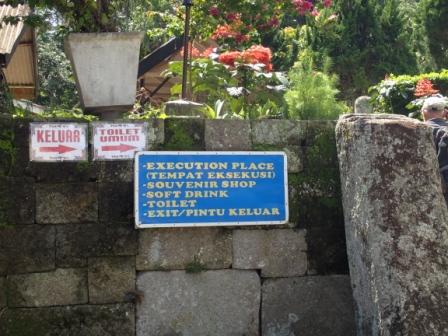
In their past, Bataks were well known for being fierce warriors. They had strong kingship systems, patrilineal clans and ritual cannibalism.  From my cursory research there seems to be a bit of debate about the extent of cannibalism but most sources seem to agree that they would eat their enemies that were killed in wartime and the flesh of some executed criminals.  Some sources also state that they ate their old people once they could no longer work.  The blood, heart, palms and soles of the feet were especially favoured as it was seen to enrich ones tendi, or ‘life-soul’.
Stone chairs and execution block of the traditional courts
Sign at the museum - We wondered if it was a warning to buy something at the souvenir shop or else!
Fortunately for us, this practice stopped when the missionaries came in the mid 19th Century and accomplished near total conversion, though a few missionaries ended up in the pot before the conversions were complete.  It was mainly Dutch and German missionaries who brought Christianity to the area. The main Christian religion now is The Huria Kristen Batak Protestan (HKBP) Church which is part of the Lutheran sect.  Churches dot the landscape and rarely is a mosque seen.  
One of the many churches
Catholic church Batak style
This Christian enclave in Indonesia certainly brings a different feel to the Indonesia we experienced before.  Although Christian, the Batak still practice some of their traditional beliefs.  One is the reburial of the bones of their ancestors several years after death.  In a ceremony that lasts several days the bones are exhumed, cleaned and rehoused in bone houses known as a tugu or tambak, which we saw everywhere.  This reminded us of a similar practice in the Greek Orthodox religion with their ossuaries.
Tuga  or bone house in a field
 
Stone sarcophagus
Bone house along the road
We didn’t get a chance to sample traditional Batak cuisine as it was the off season and the restaurants that were open served general Indonesian food of rendang and nasi goreng but sometimes with a Batak style using the special pepper spice, andaliman.  We did sample the Lake Toba fish which was excellent.  Also there was lots of pork available – a rarity in Indonesia.  The more unique Batak dishes were not on the menus, though having read about them I doubt we would have tried them.  One of the specialties is Saksang, pork cooked in spices and its own blood.  There are several other dishes that use a blood sauce as well.  I like rare steak but will stop at blood sauces – never tried the North England black pudding, either.
Saksang picture courtesy of Wikipedia
The Batak people have a high regard for education and one of the highest literacy rates in Indonesia.  On a Sunday afternoon we decided to do a circuit around the peninsula of Tuk Tuk; a pleasant 5 km walk.  We found out that Sunday afternoon is the time that high school students do their English practice with the tourists.  Every 500m we were stopped by a group of students who wanted to interview us.  Most of the students had very good English.  Any small mistakes in grammar were accompanied by lots of giggles and it was all good fun.  The kids were really very sweet but after about 4 interviews we had to say enough – all with good humour and jokes.

The student interviewers
Lovely girls
Music also seems to be an integral part of the Batak life.  Every night we heard jam sessions coming from the houses.  All the staff at the hotel could be heard singing while doing their work.  We went to dinner one night and as we were the only customers, the owner and his friend sat at our table and started singing and playing the guitar.  It was lovely but also the intimacy a bit confronting for our Western sensibilities.  Another night we went to a traditional Batak dance and the musicians were loving their music making.
Batak dancers
In our 5 days at Lake Toba, we only scratched the surface of this amazing area of Indonesia.  The people are delightful and friendly with a rich history.  The countryside is breathtaking – a very special place I was sad to leave.

Tuesday, 7 February 2017

Sumatra – Medan and Lake Toba


It is very interesting being back in Indonesia after 23 years but this part of Indonesia is very different from Java, Bali and Lombok where we traveled before when Pamela was 4 and Peter 21 was months (duapulu satu bulan).  

Our 40 minute flight from KL to Medan was delayed for over 3 hours.  We had a tedious wait in KL airport and arrived in Indonesia in the early evening.  We caught a crowed and run-down local bus into town then a becak to the hotel.  Yes, we were back in developing Asia – crazy transport and horrific traffic on bumpy roads.  I was in the sidecar with the luggage and Bob was riding pillion on the back of the motorcycle.  
Becak loaded up with school girls
The becak driver didn’t know where our hotel was so we had him drop us off near where Google maps said it was and ‘jalan jalan’ around the block until we found the entrance.  The hotel had lovely Wayang puppets decorating the walls of the atrium.  It was good to see these iconic symbols of Indonesia.  
 
Wagang puppet figures on the wall
We went out on the streets for dinner and it was wonderfully vibrant.  Buskers came to sing in the restaurants and cafes.  We had a fantastic dinner of Indonesian food in a fantastic, energetic atmosphere.  
Singing for the punters
Sadly, we had to leave Medan the next morning for our long drive to Lake Toba in the middle of the island of Sumatra.  Sumatra is a large island with lots of ethnic groups, wild animals (Sumatran Tiger, etc) and jungle; but as is the way of most wild spots is being is being 'developed' and the wild animals are near extinction.  The entire coastal fringe has given way to Palm Oil Plantations - it is even worse in Malaysia.  However as one moves in land more and more of the jungle survives.  We had a 5 hour drive from Medan on very congested roads to Parapat and then a 40 minute ferry ride to our destination on Lake Toba. 
Parapat from the hillside
Leaving Parapat
Our ferry
Lake Toba is a huge, fresh water volcanic lake in the caldera of a supervolcano.  The eruption of this supervolcano 75,000 years ago was thought to be the cause of the last ice age.   The lake is the largest volcanic lake in the world and measures 100 km by 30 km.  In the middle of the lake is Samosir Island where we are staying in a small town with the cute name of Tuk Tuk located on a peninsula jutting into the lake.  The island itself is quite large (5th largest lake island) and measures 44km by 19 km.  
Our hotel, Toba Village Inn
The view from our balcony
One day we hired a motorcycle and drove to the northern tip of the island.  It was very scenic; lots of little villages, vistas over the lake, rice paddies, water buffalo and lush tropical vegetation.  At the northern tip was a lovely sandy beach.  We didn't have our swimmers so had to content ourselves with wading in the shallows.  The water was crystal clear and very warm.  A tethered water buffalo was wallowing in the shallows along with us. 
Lush fields
Batu Hoda Beach
The foreshore was covered in wild flowers
Our fellow wallower
Two days later again we rented a motor scooter and this time circumnavigated the island.  We were going to cross over the island through the mountains until we saw the state of the road.  It was just much too rough for our bike and our bums.  So we took the much longer route around the island.  Even staying on the main road for the island the trip was very rough in spots and after six hours on the bike we were definitely suffering from ‘numb bum’.  However this was more than made up for by the scenery:  wonderful vistas of the lake, green fields, pine forests, waterfalls, steep hillsides, lush fields stretching to the water, little villages and bustling markets.
Sumatra pines and beautiful views
Waterfall south of Tuk Tuk
 
 
School bus Indonesian style
Rice drying
From top left: dragon fruit, limes, salaks and chokos
Mangosteens, mangoes and durians
Vegetables a plenty - love the sarong wrap on the head

Sunday, 5 February 2017

Kuala Lumpur


This was my fourth time visiting KL in the last 10 years and I was feeling a bit of ennui towards the place before we arrived.  But I am so glad we decided to spend two nights here re-acquainting ourselves with the city.  It is a fantastic, modern Asia metropolis – vibrant with all the modern conveniences but still maintaining that wonderful Asian chaos.  I love it.

We had a long trip from Sydney to Kuala Lumpur and arrived at our newly refurbished hotel, Cosmos Hotel, near Chinatown in the early evening.  We dropped off our bags and hit the streets for a fantastic dinner of street food on the vivacious streets of Chinatown.
Entrance to Chinatown in KL
Street food at its best
The next day we walked past old haunts; Merdeka Square, the Railway Hotel, the Central Market and discovered some new beauties such as the Majestic Hotel.  

Merdeka Square (Independence Square) was the location of the Selangor Club cricket green in colonial times and the site where the Malaysian flag was first raised when the country gained independence on 31 August 1957.  It is now a wonderful meeting place surrounded by old and new buildings and a great symbol of Malaysia’s past and future.
Merdeka Square with the Petronas Towers in the distance
We revisited the fantastic textile museum on the edge of the square.  The exhibits of Malaysian textile crafts have expanded and included some wild, modern headdresses, accessories, and examples of ethnic dress from East Malaysia.
Modern headdresses
Traditional dress in East Malaysia (northern Borneo)

Belt buckle - 360 gms of gold, rubies and emeralds - perhaps a bit OTT for my usual attire?
We then made our way towards the Railway Hotel where we had stayed twice with the kids.  Sadly the hotel above the grand mogul style railway station is now closed.  We are hoping they will renovate it to its former glory, though when we stayed there it was well past its prime and in desperate need of upgrading.
The old Railway Hotel and station
Nearby was the Majestic Hotel.  When booking our accommodation for KL, Bob had wanted to splurge and stay here but I put the kybosh on this as it was definitely beyond our budget.  We decided to go and have a sticky beak.  What a wonderful combination of old world charm and modern glitz.  We wondered around the lobbies, hallways and meeting rooms being suitably impressed.  Then just off the main lobby was a restaurant serving an amazing buffet lunch.  As it was after 2 and we were definitely peckish we decided to indulge.  There was every kind of food, Asian, Western, desserts, tropical juices, fruits, salads, cheeses, all expertly prepared.  As we had arrived near the end of the buffet hours we could only sample a fraction of what was on offer, much to the benefit of our already Christmas/Oz holiday extended waistlines.  The cost of this indulgence was equal to what we would pay for a lunch in Australia.  Perhaps our budget could extend to a night’s stay here on our next visit to KL.
The original entrance to the Majestic Hotel
Front Lobby of the new entrance
Orchid Room
Finally we ended up at Central Market.  The place has barely changed in 6 years since we were last here.  It was very comforting to see all the old shops, and fun to see the few new ones.  We went upstairs for a cold drink and Bob was thrilled to have an Es Kecang again.  It was the perfect end to a wonderful day in KL.
Es (or Ais) Kecang