We spent a delightful few days in
Taormina, swimming, snorkelling and sightseeing. It was a treat to be in clear water with lots
of fish about. The waters around Preveza
in Greece are quite turbid and green, not that inviting though we did swim a
bit.
Taormina is a hilltop town
overlooking the harbour and islands. The
‘strip’ town along the seafront is Giardini Naxos. The eight day feast of Mary, culminating in
the blessing of the fleet was underway while we were there. Military bands played in the town square and
there were several displays of fireworks at night.
 
We took a bus up a steep winding
road full of hairpin turns to Taormina.
The views were magnificent but the main street very touristy. Bob could hear the bongo drums starting in
his traumatized brain (a left over reaction from the touristy towns we visited
in China) so we went off a side street and started walking up a path which
turned out to be a Stations of the Cross trail leading up to a charming church. It was a hot climb but the views were
fantastic and well worth the effort.
  
Back at the anchorage we watched
the many moods of Mt Etna.
 
After three days it was time to
move south down the coast to Siracusa (or Anglicised – Syracuse). After a 10 hour motor sail we rounded the
point with the ubiquitous fort on the headland.
Siracusa is a sizable city with a large harbour. We anchored in the late afternoon and had a
welcome sundowner while watching the other boats come in.
 
We spent the next week exploring
this pretty old city. In the Cathedral
in the beautiful Piazzo Duomo hangs the Caravaggio
painting “The Burial of Saint Lucy” – magnificent. Another square had the impressive fountain of
Diana and Arethusa. We stopped at a café
overlooking the fountain and discovered a wonderful refreshing sorbet type
drink called Granitas – perfect for the hot days.
 
The legend of Arethusa continues with a waterfront fresh water pool and
fountain, Fonte Aretusa. This is supposed
to be the place where the nymph, Arethusa emerged from the sea after fleeing
her home in Arcadia. Here grow natural
Papyrus plants, the only place in Europe where they grow.

Another day we trekked above the city to the Greek and Roman
amphitheatres. Nearby is the limestone
cave called the Ear of Dionysius, a name coined by Caravaggio in 1608. The cave is suppose to have excellent
acoustics where even a small sound resonates throughout the cave. Bob gave a loud ‘Cooeee’ but it didn’t make
much of an effect.
    
On the way we passed the ultra-modern Santuario della madonna delle
Lacrime (Sanctuary of our Lady of Tears), a church opened in 1996 to honour an
event that happened in 1953. A plaster
statue of the Virgin Mary was seen with ‘tears’ rolling down her face. This condensation on the statue was
considered a miracle and ‘scientific analyses’ at the time determined the fluid
was human tears. Construction of the sanctuary
began in 1966. During the excavations
the ruins of houses from the 6th Century BC were found. Twenty-eight years later the building rising
74 metres above the city was completed.
We enjoyed our week in Siracusa,
all the more so for having met up with a couple from the MedNet. The MedNet is a SSB radio schedule that runs
during the summer. Cruising sailors from
all over the Mediterranean check in to let people know where they are and that
all is well. We have been talking with
this group for a few years and it was great to meet some of the members in
person. We had a lovely time socialising
with Brad and Ruth from Korsar- a
perfect finish for our time in Siracusa.
|
Tuesday, 18 September 2018
Taormina and Siracusa, Sicily


Wednesday, 5 September 2018
Heading to Italy: Our First Multiday Passage on Songster
 |
| On the water again |
 |
| Saying goodbye to the boat yard dogs |
Then I realised I was due for another visa run (I hate this Schengen policy) in about 10 days time. After looking at options to go to a non-Schengen country from Sicily, we decided the easiest and cheapest option was another ‘lunch in Albania’ visa run. So we turned Songster north towards Corfu via pretty Parga.
 |
| A bit of rocky-rolly on our way to Parga |
 |
| Nice to be back at 'our' spot in Corfu |
 |
| The massive and incredibly ugly sailing yacht 'SY A' owned by a Russian businessman |
Stamped into the Eurozone for
another 90 days we were ready for the big multi-day passage to Sicily. Finally I felt we were going to do some real
sailing. Enough of nearly 4 years of cappuccino
cruising; doing easy day sails, island hopping around Greece and Turkey. As fantastic as it has been, I wanted a bit
more of a sailing challenge. Bob and I
had done overnight passages before but always as crew, never just the two of us
and fully responsible. So we had a
pre-dawn departure from Corfu to our destination of Taormina, Sicily, about
270nm away and 60 hours of non-stop sailing ahead of us.
 |
| Pre-dawn departure |
 |
| Just sea and sky for 360 degrees |
 |
| Sunset the first night |
 |
| and sunrise the next morning |
 | |||||||||||||||
| Mt Etna in the haze |
 |
| View from the cockpit |

Saturday, 25 August 2018
The Farthest North – Honningsvåg and Beyond

The next day on our Hurtigruten cruise
we rounded Nord Cap, the most northerly point of the Norway mainland – the John
0’Groats of Norway – and stopped at the picturesque town of Honnegsvåg. At 71⁰N it is the most northerly European town.

 |
| Honnegsvåg harbour |

We took a walk along the hill behind
the town and were treated with some delightful views and a multitude of
beautiful wild flowers.
 |
| Overlooking the town |


 |
| Wild orchids |
 |
| Heather, but smaller and lower to the ground than what we saw in Scotland |
 |
| A peaceful resting place. The inscription says 'Thanks for everything' |
What struck us about these little
towns above the Arctic Circle was how normal they seemed. The towns consisted of colourfully painted
wooden houses with pretty gardens of bright flowers, green grass and trees. Bob had spent a year at Casey Station in Antarctica
which is located at 66°17’S or 26 nm short of the Antarctic Circle. There the average high never rises above
freezing and ice and snow cover the ground year round. Here we were at 71°N and people are mowing
their lawns! It just shows the powerful
effect of the Gulf Stream on the climate in these parts. One wonders what would happen to Norway (and
all of Northern Europe) if the Gulf Stream ever changed course.
On our way back to the ship we met up
with Martin and Elspeth, our mess mates for the last week. These intrepid cyclists were leaving us to
ride their bikes from North Cape back to Trondheim over the next 5 weeks – over
2000 km. This is just a short ride for
them as about 6 months ago they had finished cycling around the world over a
two year period. We will miss them as
mess mates but look forward to following their travels on their blog. https://www.crazyguyonabike.com/directory/?user=Elspmart1
 |
| Martin and Elspeth off on their 2000 km Norwegian tour |
We travelled on enjoying the scenery and stopping briefly at little towns such as Mehamn and Berlevag where the MS Lofoten brings vital supplies and fishing is the main industry.
 |
| Cathedral rocks |

 |
| Mehamn harbour |
 |
| Fish drying on harbourside racks |
 |
| Delivering building supplies in Berlevag |
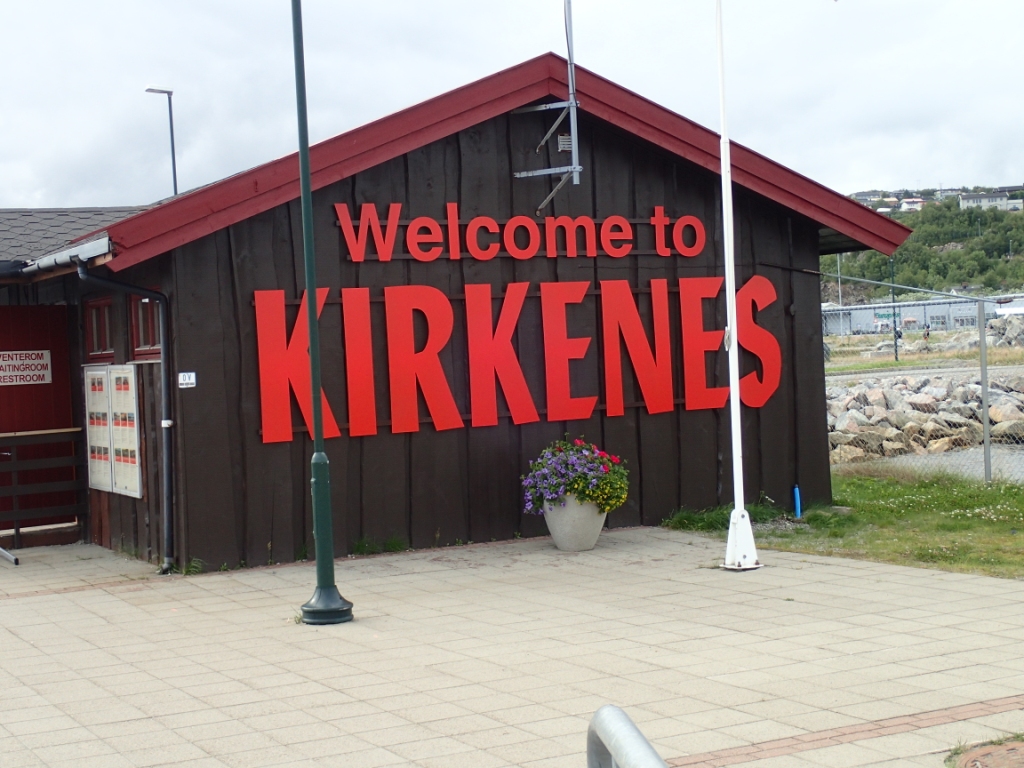
The next day we arrived at Kirkenes, the
half-way point in our journey and the start of the return southbound trip. Kirkenes, at 30°02E, is further east than St
Petersburg and only a few kilometres from the Russian border and Murmansk. It was a quiet, pretty town.
 |
| Watching for the Russians |
 |
| Tidy houses of Kirkenes |
As with all these towns above the
Arctic Circle, we were struck by the homogenous multiculturalism of the modern
world. Everywhere we go we see Kebab
shops, Asian food stalls, Pizza parlors and the faces of a wide mix of ethnic groups. The products in the shops were the same
brands one gets everywhere in Europe and Australia. One expects this in big cities but we were
amazed to see such diversity in these remote small towns. Ironically the one ethnic group we did not happen
to see were the original inhabitants of the area, the Sami people.

 |
| The menu is pan-Asian - sushi, Thai Red Curry, Tikka Masala and everything in between |
On our southbound journey we stopped
at some different ports or the same ports at different times so we could see
them during the day time. We had a short
stop at Vardø where we all trouped off to check
out the 18th Century fortress overlooking a blustery coastline. Vardø is
also where Nansen returned to Norway after his 3 year expedition towards the
North Pole.
 |
| The outskirts of Vardø |
 |
| The wall of the 18th Century fortress |
 |
| Tour Guide |
 |
| Polar Bear Pub |
Subscribe to:
Posts (Atom)