Sailing

Sailing: the fine art of getting wet and becoming ill while slowly going nowhere at great expense.

Tuesday, 17 December 2019

New Rigging and on to Mindelo – the passage from hell!


Once we returned to the pontoon after our near catastrophic rigging failure following the start of the ARC+ Rally from Las Palmas, we got in touch with the Oyster crew for some advice about repairs.  Although it was a Sunday afternoon, Eddy and Andy were there within the hour.  They checked out the damage, were obviously quite concerned but incredibly professional.  They were extremely reassuring and I found my heart rate beginning to return to normal.  They promised to be back first thing Monday morning.

Eight o’clock the next morning the team were there checking every bit of the rigging.  We wanted to replace all the Norseman fittings.  Essentially it was decided to replace all the rigging as it was over ten years old, except for the fore and back stays which had been replaced last year in Lefkas.  Oyster negotiated with Alisios, the rigging shop, for the work to be done.  They were brilliant.  In a day and one half they made up and replaced 7 new shrouds with swaged fittings.  Then the Oyster crew returned to tune the rigging and make the final adjustments.  By Tuesday afternoon the work was done and Songster was better than ever.
Will from Oyster and Reg watching the riggers
Andy up the mast
One of the men from Alisios
We could have left that afternoon and been only 2 days behind the fleet but we felt it was more prudent to get a good night’s sleep and have a full 12 hours of daylight to get into the groove of our 6 day passage to Mindelo.  At daybreak on Wednesday we once again dropped our mooring lines and left Las Palmas for Mindelo.
Leaving Las Palmas - take 2
There were about 3 other boats that did not start with the main rally.  They delayed their departure because they wanted a better weather window.  We had had a briefing from the meteorologist and the weather did look like it would be a bit less blustery on Wednesday than it was on Sunday when the rally started.  One of the boats, Catweazle left with us on Wednesday morning and we sailed in company for a few hours.

The passage to Mindelo was rough.  We headed south from Gran Canaria and went wide to avoid the notorious acceleration zone located southeast of the airport area.  About an hour into the passage the sea state became confused with 3-4 metre swells.  Suddenly I began to feel a bit queasy and then was hit by full on Mal de Mare.  I never had this before on Songster.  Fortunately it lasted for only 24 hours and then I had my sea legs.

Although I had gotten my sea legs back, the sea state never really improved for the whole passage; continuous confused seas with 3-4 metre swell and surface waves in different directions, winds gusting to 25 – 30 knots.  It was impossible to do anything below decks as we were being tossed about.  Everything had to be done by bracing ourselves against bulkheads and holding on with one hand.  Meal preparation which was just heating up our pre-prepared meals was still an ordeal.  

We had to wear full foul weather gear on night watches.  Songster, with its high freeboard, had never gotten more than a few drops of water in the cockpit during her sailing in the Mediterranean.  But the high freeboard was no match for the Atlantic conditions we were experiencing.  We were frequently getting waves splashing into the cockpit.  One night on my watch, a wave came right over the side of the cockpit, straight down the companionway and landed on top of Reg’s head as he lay sleeping in the lee berth.  Poor Reg got water in his ear and couldn’t hear for a few hours.  For the next 24 hours until conditions settled down a bit, we had to sail with the washboard in the companionway to keep things dry below.

For a video of the waves see: https://youtu.be/CWR2gry2lpE  
But the waves never look as big in the pictures.

On the approach to Mindelo the wind funnelled between the islands causing choppy seas and nasty gusts – just to end a bad passage with a final kick.  Finally after 6 days, 7 hours and 30 minutes we completed the 898 nm passage from the Canaries to Cape Verde.  It was a fast passage, averaging 5.9 knots, but a rough one!
Approaching Mindelo on Sao Vicente
 
898 nautical miles from Las Palmas to Mindelo
As we approached our berth in the marina, the crew from Wolo, Marco and Luci, were waiting to greet us with beers in hand.  Lots of people came up to us saying how they were so glad to see us and were worried about how we were doing after our rigging failure.  Everyone also admitted that they had had quite rough passages as well.  Some of us who had never sailed the Atlantic were a bit concerned that conditions would be like that all the way across to the Caribbean.

That night was the prize giving ceremony.  It was held in a lovely old fish factory cum event centre.  Everyone was in a jubilant mood having gotten through the rough passage to Mindelo.  A fantastic local rum punch was served and lots of Cape Verdean food specialities.  I took a fancy to the fried flying fish – delicious.  A local dance troupe gave a performance – could they move!  And of course Phoebe joined in too.

 For a video of the dance troupe see:  https://youtu.be/2lUcvH2vsI0

 
The dance troupe in Mindelo
Phoebe getting in on the action
The sailors listening to the presenters
The evening was a great introduction to Cape Verde.  Cape Verde is an archipelago of 10 islands located about 600 km off the Northwest coast of Africa.  These islands were uninhabited until the 15th Century when the Portuguese colonized them.  The area became integral to the Atlantic slave trade and a haven for merchants, privateers and pirates.  The archipelago gained independence from Portugal in 1975.  Today Cape Verde is an important commercial centre on the trans-Atlantic shipping route.  The country is one of the healthiest in Africa and ranked as a medium developed nation on par with the development of Morocco.

I was really looking forward to exploring the town the next day.  Sadly we arrived too late for the complementary tour of the island that was provided by the ARC+ Rally. Mindelo is located on the island of São Vicente with an island population of 70,000 people.  We spent our one day on the island walking around the pretty town of Mindelo and taking in the atmosphere.  I found the people of Mindelo strikingly beautiful, friendly and proud of their island nation.
The streets of Mindelo
Art relief at the Markets
Reg relaxing on the minimalist bench at the markets
We were sad to leave the island so soon.  I would have dearly loved to further explore this appealing country and its beautiful people but the Atlantic Crossing was ahead for us.

Wednesday, 11 December 2019

The Rally Start and a Big Bang!


The week before the official start of the ARC+ Rally, Phoebe and I spent 3 days cooking, freezing and vacuum packing meals for the passage.  A large Canadian catamaran on our pontoon, Two Canoes, kindly loaned us their portable freezer while they were off for a few days sightseeing.  The freezer on Songster will keep things frozen but only if they are already frozen solid.  By the end of the marathon cooking session our freezer was absolutely stuffed with nearly 20 main meals just ready to be thawed and heated while on passage.  Plus we had lockers full of tinned and dried food for more meals.
Prepping the veggies
Last minute extra provisions
Then on the first of November the official activities of the ARC+ Rally started.  The next 10 days was a whirlwind of safety inspections, seminars and lots of social activities.  The benefits of joining a rally rather than crossing independently really came to the fore over this time.  The seminars were very good and informative.  We went to talks on Weather and Routing, Provisioning, Management of Emergencies, Downwind Sailing Tips, Communications, First Aid at Sea and an interactive Liferaft Demo.
All the emergencies we could be facing
Checking out the grib files
Life raft demo
Every night was a social activity.  There was the welcome party, daily sundowners, crew dinners, a costume party (we didn’t go to this) and on Friday the big Farewell party – given two nights before the start to ensure people had clear heads on the Sunday of the rally start.  There are nearly 100 boats participating in the ARC+ Rally which includes 450 people, 80 are children sailing with their families.
Celebrating with new friends from Wolo and Xerric
Some of the children going on the ARC+ Rally
The welcoming party
Crew dinner
 One of the added benefits for us was that Oyster Yachts, the manufacturer of Songster, provides a whole team of very professional, knowledgeable and friendly staff to inspect all the Oyster yachts in the fleet.  The ARC+ Rally had about 8 Oysters and the larger ARC rally starting two weeks later had about double that number or more.  

Now our little Oyster 39, built in 1979, is definitely the very poor cousin to the modern Oyster Yachts that are mostly over 60 feet long, very luxurious and cost ten times more than our little boat.  But the team of Eddie, Gavin, Paul, Will and Andy from Oyster were fantastic – thoroughly nice guys that were really fun to talk to.  They were genuinely interested in our boat and seemed impressed with the characteristics of this ‘classic’ Oyster.  They offered lots of helpful suggestions about the various systems.  A thorough check of all the major systems; steering, deck fittings, sea cocks, generator, engine was done and they spent nearly 2 hours with us.  When they left on Thursday afternoon they said a rigger would be by to check the rig and apologised that this was delayed but their normal rigger was ill and they had to fly another in from England.

On Friday night Oyster had a cocktail party at the very pretty hotel, Hotel Santa Catalina, for all the Oyster crews.  It was a very pleasant get together with great canapés and plenty of wine.  From there we went to the ARC+ Farewell Party, a much bigger do with a live band and even more wine and beer flowing.  I was beginning to feel like we were going from one booze-up to another all week!  Anyway it was a great time and Reg and Phoebe danced the light fantastic.
Live band at the Farewell Party
Reg and Phoebe enjoying the music
The next afternoon Andy, the rigger from Oyster, came to check our rig.  He found that the baby stay had some broken strands and needed to be replaced.  The local rigging shop, Alisios, was fantastic and quickly made up a new swaged shroud for us and Andy installed it by nightfall.  The team returned the next morning, a few hours before the start of the rally, for a quick tuning of the shroud and apologised that they ran out of time to check the rest of the rigging.  As all this work was gratis and an added bonus for us, we were just grateful these great guys came along to check what they did.  Ultimately the responsibility for our boat is ours alone.  However the rigging proved to be our Achilles heel. 

The big start of the rally was at 1 pm Sunday 10 November.  We dropped the mooring lines a bit after midday to head out to the starting line.  There was lots of good energy in the air.  Everyone was excited, wishing each other all the best.  It was a great sight to see 94 boats lining up ready to start the ocean rally.  It is not a race but there is a saying that whenever there are two or more sailboats on the same body of water then it is a race.  The conditions were blustery and waves quite high.  Everyone was anticipating a fast first leg of the rally.
Heading out to the start
Approaching the start line
Waves blocking out the hulls of the boats
Some more of the fleet
Songster zooming along
We were zooming along with a mizzen and the genoa when there was a loud BANG and the port (left) intermediate stay on the main mast had detached.  The Norseman fitting which fastens the metal shroud to the deck had just cracked in two.  The main mast was swaying dangerously.  The crew all did what needed to be done and no one panicked.  We quickly got the sails in and tightened the running back stay to give some support to the swaying mast and limped back to port.  We were all safe but with very increased heart rates and, of course, we were feeling rather sad and disappointed.  We were just grateful that this major rigging failure happened only a few miles out of port and not 1000 miles into the Atlantic.
The shroud on the far left was the culprit that failed
The cracked Norseman fitting

Saturday, 9 November 2019

On to Las Palmas


It was time to move on to Las Palmas on Gran Canaria to start the final preparations for the ARC+ Rally.  As the distance between the two islands is about 94 nm, which would take about 17 hours, we decided to do a night passage to get us to Las Palmas early morning.  What a night!  We had a hideous passage.  A large storm in the northern Atlantic was causing a very nasty sea state hundreds of miles away in the Canaries.  The boat rocked and rolled horribly.  No one got any sleep and we were a grumpy lot as we approached the busy commercial harbour of Las Palmas just as dawn was breaking.  A small consolation was that we found out in the subsequent weeks that everyone else had a bad passage to Las Palmas.  You can’t argue with Mother Nature.
Approaching Las Palmas at day break
Our first few days in Las Palmas were taken up with doing all those jobs identified on the passage down to Las Palmas.  The first priority was to fix the gimballed stove and oven.  On a boat this appliance is on gimbals so that it stays level when the boat rocks.  On the way down in the rough seas the stove would get jammed and there was a real danger of hot food falling on the floor or worse, on the cook.  Reg and Bob spent a day taking out the stove and adjusting the height so it would swing freely.  

Next the sail plan for downwind sailing had to be set up and tweaked with the rest of the crew so everyone knows how things work.  We have a couple sails for light winds such as the spinnaker and mizzen stay sail.  We bought a second hand storm jib for nasty weather (hopefully we will never have to use that one).  Finally we had a spare No. 3 Genoa to set up as twin head sails with our 150% main genoa.  We plan for this to be our main downwind sail plan in the trade winds when the winds generally will be between 15 - 25 knots.

Phoebe and I (mainly Phoebe, cook extraordinaire) worked on meal planning, tweaking the galley set up and making provisioning lists.

With the major jobs done we had a few days to see the island.  We hired a car for two days and toured around the island.  Gran Canaria.  The main city of Las Palmas is not at all as I imagined but quite nice none the less.  Las Palmas is a city of over 300,000 people.  At first we were all disoriented at the big, bustling, modern, prosperous and upmarket city around us.  This was not what I expected on a small island in the Atlantic off the coast of Africa!  It is more like Barcelona or the French Riviera.

Gran Canaria is quite different from Lanzarote, much lusher and more developed.  The island is essentially a 50 km volcanic circle and can be easily seen in two days.  On our first day we headed south to the fantastic sand dunes of Maspalomas.  Unknown to us, nude sunbathing is de rigueur.  Walking along the beach we saw much more of middle aged bodies than we really wanted to but the sand dunes and natural scenery was stunning.  
Sand dunes of Maspalamas
  
The gang
We moved west along the south coast to the pretty port of Puerto de Mogan for some lunch.  This was a charming harbour lined with white washed buildings trimmed in pastel colours and bright bougainvillea.
 
 
The steep headland cliffs at Puerto de Mogan and the development dug into them
From Puerto de Mogan we headed inland up spectacular (and scary) twisting mountain roads to Roque Nublo and Pico de las Nieves, the highest point on the island at nearly 2000 metres.  The whole area is filled with amazing volcanic rock formations.  Roque Nublo is the most noted formation, measuring 90 metre in height formed by volcanic clouds hardening and cooling.
Roque Nublo
Roque Nublo from the road
   
The twisting roads up the mountain
The views from Pico de las Nieves were stunning.  We marvelled at the fantastic volcanic rock geology and spectacular views.  We could see down to Las Palmas and to the west, the islands of Tenerife and La Gomera in the mist.
The view from Pico de las Nieves.  Tenerife is in the distance and beyond that the flat island of La Gomera
View to the coast and Las Palmas
Looking north
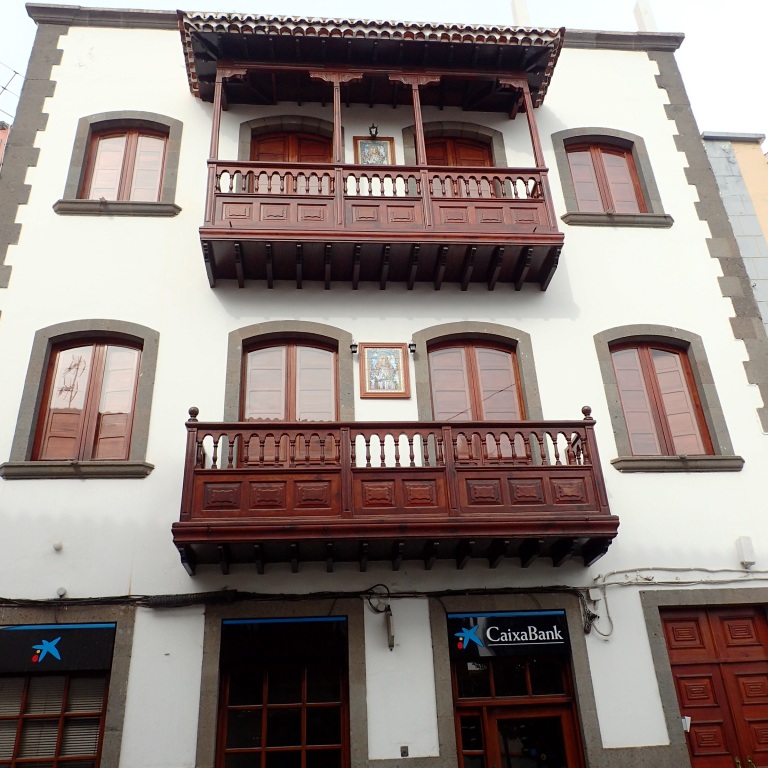
The second day we explored the northern parts of the island, hopping between charming mountain villages.  First stop was the town of Teror, known for its architecture and pretty wooden balconies that reminded us of Turkey.
 
 
The charming buildings of Teror
Next stop was the rum distillery at Arucus.  The Arehucus distillery produces 3.5 millions of bottles of rum annually and makes 20 different varieties of spirits, 9 rums and 11 cream liqueurs.  After the interesting tour of the factory it was time to do some taste testing.  Bob and Reg were taken with the 12 and 18 year old rums so bought a few bottles which quickly disappeared over the next few weeks.
Rum barrels
Famous people come to the distillery and sign the rum barrles.  This barrel was signed by Placido Domingo.
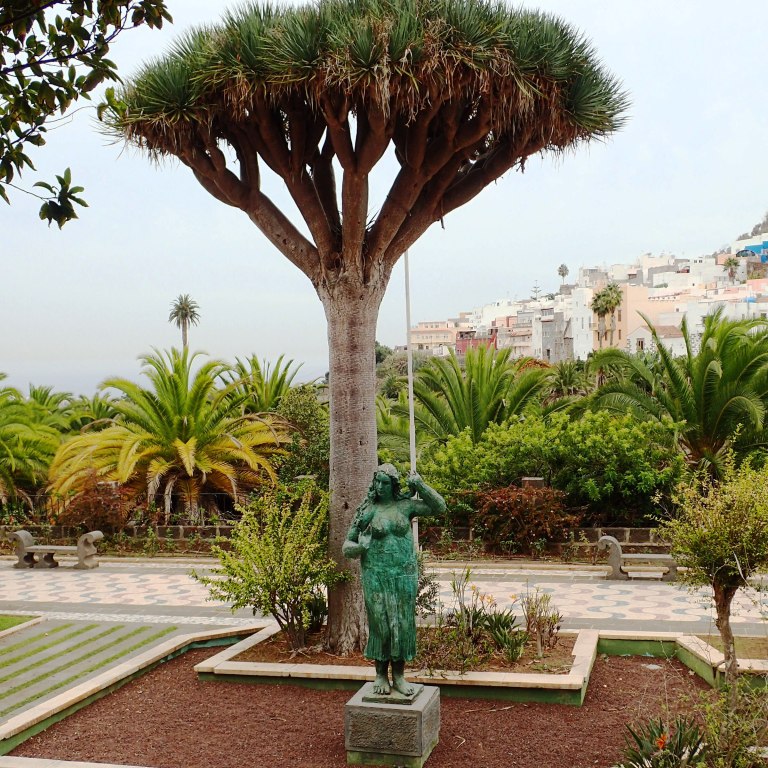
After the rum tasting we went for lunch in the town.  We found a very nice café near a beautiful neogothic church.  Afterwards we walked back to the car through an attractive public garden with odd shaped trees.
A nice backdrop for lunch
Reg dwarfed by the massive church
The park in Arucus
The final stop was the quaint town of Firgus, known for its waterfall in the centre of town, its bottled spring water and its tile plaques representing the different towns of the Canary Islands.
Waterfall in the centre of Firgus
 
 
The tile plaques along the waterfall
We got a lovely taste of the island on our road trip and went back to Las Palmas into the rush hour traffic and crazy roundabouts and slip way roads to the marina.  Sightseeing finished, it was time to tackle the provisioning and final preparations for our Atlantic Crossing on the ARC+ Rally.  That will be for the next blog post but as I am writing this post just one day before we leave, the next blog entry will probably be posted when we arrive in the Caribbean early December.