Sailing

Sailing: the fine art of getting wet and becoming ill while slowly going nowhere at great expense.

Monday, 1 May 2017

Medieval Villages of the Mastichochoria in Chios


Chios has quite a chequered and sad history.  As with all the islands in the Aegean, Chios has been occupied by the various empires; Greek, Roman, Byzantine, Venetian, Genoese and Ottoman.  Throughout these occupations the villagers, as villagers always do, just got on with their lives as best they could, raising their crops and herding their goats.  

One of the special crops grown in the southern part of the island was Mastic.  Mastic is a gum resin from the Mastic tree, an evergreen shrub that thrives in the arid, stony soil of southern Chios.  This is the only place in the world where the climatic conditions are just right to produce the mastic resin.  The resin has been a major trade commodity since antiquity and used in medicine, cooking, religious ceremonies and cosmetics.  To protect this valuable commodity from the frequent pirate raids, the Genoese in the 13th Century build fortified villages in the hills called Mastichochoria.  These medieval villages were the main attraction for our visit to the island.
Mastic Village
Our first stop was the Mastic museum just outside the village of Pygri.  This is an excellent museum with very informative and first-rate exhibits explaining the whole production of the mastic resin, its history and commercialisation.  A mastic tree can live for 100 years.  It starts production of resin after about 6 years with production peaking at 15 years and declines dramatically after 70 years.  Peak production is only about 200 grams of resin per tree.  The harvesting is all done by hand.  Small incisions are made in the bark of the tree and the resin drops, ‘the tears of Chios’ are collected and cleaned in a long labour intensive and multi-stepped process.
The mastic tree
The leaves of a mastic tree
The tears of Chios
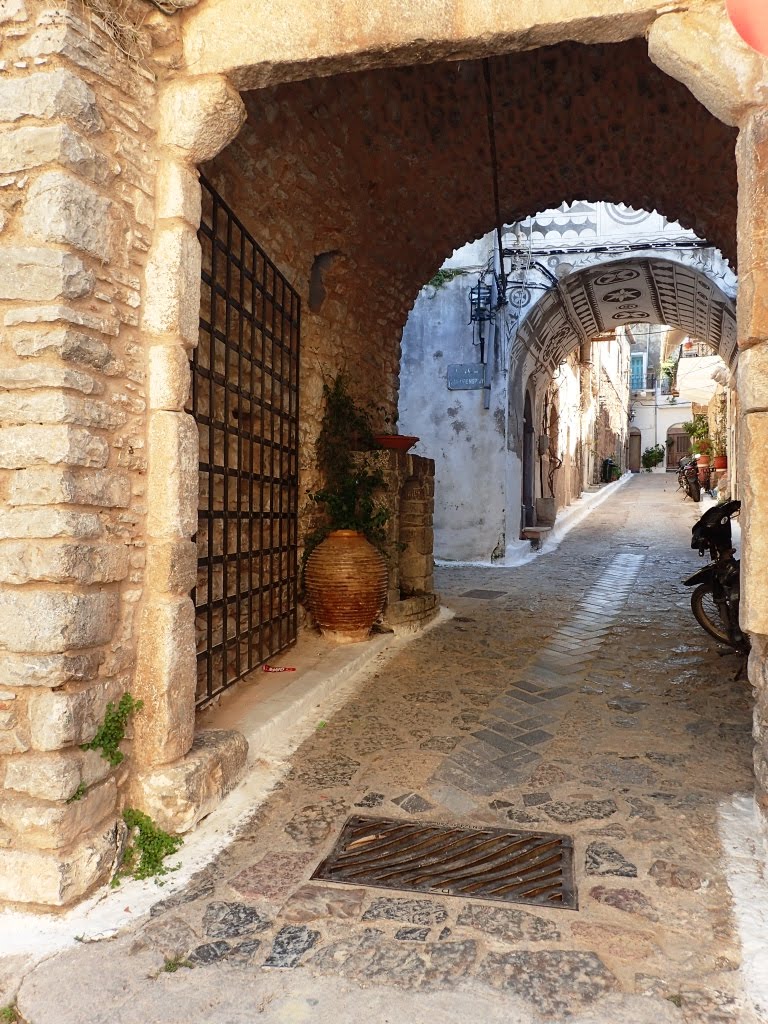
Then on to the villages.  We visited two of the seven villages, Olympi and Masta.  These walled downs are a labyrinth of narrow alleys and small dark houses opening up to the occasional delightful square with wonderful tavernas.  
Enjoying a Chios beer and a sample of Mastika, the liqueur made from mastic
The decorative walls of the village


Insert photos
The population of the villages now is much reduced.  Given the history of Chios, the villages’ survival is just short of a miracle.  Although the mastic villages enjoyed special privileges during the Ottoman rule, when the island joined the Greek War of Independence in 1822, over 50,000 of Chios residents were slaughtered, another 50,000 managed to flee the carnage leaving only about 20,000 Greeks left on the island.  
Delacroix's painting of the massacre at Chios
Then about 60 years later a strong earthquake destroyed many of the buildings and killed another 10,000 inhabitants.  Finally in recent years several large forest fires have destroyed many of the trees.  We drove through many bare hillsides with only the stumps of charred trees remaining.  I didn’t take any photos.  It was all too sad.  I hope the resilience of the people of the Mastichochoria will ensure the tradition of mastic cultivation continues.  They have survived slaughter and earthquakes but can they and the trees survive the effects of climate change??
Spring flowers were everywhere
The quiet village square

Saturday, 29 April 2017

Chios (Χιος) – Refugees and Old Castles


Windmills of Chios
The winds were fairly strong from the north during our time in Karlovasi with the wind howling up to 55 knots on one of the days.  We had five lines and springs tying us to the quay and Songster was nicely secure.  Finally after 5 nights in Karlovasi harbour we finally had benign weather predictions so it was time to move on.  While in Karlovasi we had befriended the one other yacht which was moored on the quay.  Bat Yam is owned by a lovely Israeli couple who had two friends also on board.  We had drinks on their boat and amazingly found a mutual acquaintance.  The world is a small place.
We started for Chios early in the morning.  It was drizzly and dreary.  We were kitted up in full wet weather gear.  With the wind predictions we thought we might have a reasonable motorsail to Chios but the winds on the preceding days had stirred up the sea and we had a rather bouncy and rough motor only to Chios.
Bashing through the waves
Bob in wet weather gear and nautical hat
 
After about 6 hours of bashing through the waves with the wind on the nose, we arrived at Chios marina, just north of the main Chios harbour.  This marina is one of many disused, half-built marinas dotted around Greece.  There are spaces to moor alongside but no electricity or water facilities.  The area is a bit of a shambles with some abandoned boats but the harbour offers good protection, it is an easy walk into town and its free.  The local fishermen have taken over the place and moor their boats on the smaller wharfs but there is room for half a dozen visiting yachts.  
Songster in the abandoned marina of Chios
Our first day on the island of Chios we explored the main town.  Along the waterfront road we noticed a little harbour down a side road.  We went to explore and found an empty but sizable enclosed harbour.  Along the rocky shoreline were dozens of silver UNHCR tents occupied by Syrians – young men and families with small children.  The camp extended all along the old castle wall.  We talked to an aide worker, an Irish woman working for the NGO called ‘A Drop in the Ocean’ which offer support and bring supplies to the refugees.  Unlike the Australian concentration camps for asylum seekers, the refugees in Greece are free to come and go from the camp and integrate into the community.  We asked a few locals how the refugees were received and they all said there were no issues.  Nevertheless, it was sobering to see the rough conditions they were living.  The nights are still chilly here and living in small tents on a rocky beach would not be pleasant.
UNHCR tents on the rocky beach
  
Refugee camp under the castle wall
We walked on into town and went into the castle.  This castle is known as the ‘new’ castle as opposed to the ‘old’ castle which dated from Byzantine times.  This new castle was built mainly by the Genoese in the 14th Century then taken over by the Ottomans in the 16th Century until 1912 when the island became part of Greece.
Eileen outside the castle
We expected the usual crumbling ramparts and a few old ruins.  Instead we found a complete community of houses along narrow winding streets.  Some buildings had been renovated and others were near collapse but the area was quite a thriving community.  Many were in the Turkish style of overhanging enclosed balconies. There was a beatuifully restored Turkish Hammam (public baths) that was lovely.  Walking around was a taking a step back into time.
Renovated stone house
The Turkish style balconies
One earthquake tremor and this will go
Restored Hammam

Thursday, 20 April 2017

On the Move Again and Close Encounters with a Monk Seal


Good Friday was our last day in Kos.  The marina distributed plates of Easter sweet breads and bright red hard boiled eggs.  The eggs are dyed bright red to signify the blood of Christ.  The Greeks play an egg cracking game with these eggs called tsougrisma (τσούγκρισμα) which symbolizes the breaking open of the tomb and Jesus Christ’s resurrection from the dead.
Easter sweet breads and eggs - a gift from the marina
In the evening is the procession of The Epitaph.  After a church service, an elaborate wooden bier, symbolizings the tomb of Jesus, adorned with fresh flowers (and the modern touch of LED lights) is carried from the various churches through the streets of the town.  All the biers are brought by their congregation to the town square where the sombre rites continue to midnight.  We walked into town to watch the beginning of the procession but could not stay on as we had an early start in the morning.
The faithful waiting outside the church for the Epitaph
The Epitaph procession
Up early the next morning for our passage to Leros.  About an hour after setting out of Kos harbour a Turkish Coast Guard boat comes towards us.  We of course were checked into Greece but in those waters the two countries are so close that it is impossible to go from one island to another without criss-crossing the borders.  The Coast Guard ship circled us then called us up on the radio, asked us to turn off our motor and then came along side, tied up to us and then ask to see all our papers.  They were very polite and even apologetic, explaining it was all routine.  Fortunately the sea was dead calm with no wind so it was fine to have the large Coast Guard boat tie up alongside our little boat.  I suspect that is why they chose to stop us - good practice for the crew.
Turkish Coast Guard waving goodbye after checking our papers
Mid-afternoon we arrived at Alinda in Leros.  We were the only yacht around and able to pick up a mooring.  We settled in to relax for the rest of the afternoon and evening.  We didn’t bother to go ashore and happily stayed on the boat to prepare for an even earlier start the next morning.

Alinda, Leros
 
Just after sunrise we dropped the mooring line for our long passage to Karlovasi on the northern side of the island of Samos.  We managed to do a fair amount of sailing in the light southerlies but had to motor for the last two hours so we would get into the harbour before dark.  After a 10 ½ hour passage we entered a deserted harbor with friendly Greek Coast Guard at the ready to catch our lines as we pulled alongside the town wharf.
Only visiting yacht in the harbour of Karlovasi
The next day we took a walk to the nearby fishing harbour.  We were walking along the wharf, Bob was a few paces ahead of me.  He had just passed what at first looked to me like a rolled up carpet.  I stopped to look and realised it was a seal.  At first I thought it was dead as I was only a foot away and it wasn't moving.  I called Bob back. (He had walked right passed without noticing anything.)  Sure enough we saw the seal was sleeping without a care in the world.  Bob has had lots of experience with seals in Antarctica so knew we could pat her and not disturb her.  She was such a slug.  We patted her belly, walked all around her and she barely blinked.  Nothing was going to disturb her nap.  Despite the seal’s total indifference, it was all quite exciting for us. 

When we got back to the boat we Googled Mediterranean seals and found out it was a Monk seal.  They are very rare with only an estimated 700 left in the wild.  What a privilege to have had such a close interaction with such a rare and beautiful animal - even if she did have a brain the size of a pea and was a total slug!
Bob tickling the Monk seal's belly
A slight lifting of the head was the only reaction we got from this slug-a-bug
So we have settled into the berth at Karlovasi, watching the huge ferries come and go, resting and waiting for the next good winds to our trip to Chios.

Huge ferry docking on the wharf about 50m from us
  

Friday, 14 April 2017

Laid Low in Kos


As seems to be the case much too often, the wind forecasters and Mother Nature are not on the same page.  We left Symi at the crack of dawn to take advantage of the predicted perfect winds for out northwest passage.  What we got was a dead calm for the first three hours, then the predicted winds for about two hours then for the rest of the passage dead calm again.  So the iron spinnaker once again got quite the workout and the sails only a light exercise.  Still there were some compensations.  About an hour out a pod of dolphins visited us.  This was the first time we had seen dolphins on passage.  Once we saw a dolphin in harbour in Emborios but this was the first time ‘at sea’.
Dolphins
 
 We tied up to the town wharf by mid-afternoon.  Bob had come down with the flu again and was feeling pretty miserable.  Given his history of pneumonia we decided to be very cautious and sought out a doctor to check him out.  As a retired epidemiologist, I find these interactions with the health care system in different countries quite interesting, if only it wasn’t Bob who was always getting sick!  We came away with the diagnosis of febrile Bronchitis, not pneumonia and a list of medication to relieve the symptoms, to which we added a few of our own home remedies. 
Bob taking the remedies. We found the Bailey's especially helpful!
We resolved not to leave Kos until Bob was better.  We did not want to be on some remote island without good medical care if Bob’s condition turned worse.  We had a good explore of Kos Island last year when we were here so were not too bothered by vegging out for awhile while Bob’s immune system did its thing.  After a few days at the town wharf we decided to move into the marina as the wind had picked up and the harbour was getting an uncomfortable swell.

By this time the inevitable happened and I came down with the dreaded lurgy.  Fortunately Bob was beginning to be on the mend by this time so I had a good nurse to get me through several days of shivers and shakes, sneezing and coughing.  It is a nasty bug and all the more so as we had just gotten over a similar infection a month ago.  Our stay in Kos was delayed a few more days but not without some compensations – beautiful sunsets and reconnecting with Australian cruisers Sal and John who we befriended in the winter of 2016 at Marmaris.
Sunset over Kos